
Hello, and a huge welcome to this week of the 2026 Vibrant Vintage Crochet-A-Long (VVCAL)! I’m so glad you’re here! I love spending this time with the VVCAL community. We are going to have so much fun relaxingly working through these motifs each week.
Attention!
If you have not yet seen the Week 11 Instruction post, please head there first and see the instructions for the version that you are working. Below, you will find the Motif pattern, in US, and UK Terms, Chart, Video, and Step by step photos.
Social Media Hashtags: #VVCAL and #CypressTextiles
PDF Version
2026 VVCAL PDF is now available! In US and UK terms
- 36 hexies to mix and match
- 3 Joining methods
- Wide Lace Border
- US and UK Terms included
MEGA PACK! Of course I have also created a value bundle for you – 2022, 2024, and 2026 VVCAL PDFs US and UK Terms – Hexagon VVCAL Mega Pack Available on:
2026 VVCAL Quick Links
- 2026 VVCAL Main Information Page
- 2026 VVCAL FAQ Tips & Tricks Page
- 2026 VVCAL Ravelry ebook Motifs link back to their blog posts. Favorite the hexagon, add it to your Ravelry queue, see others’ projects, and more!
- Vibrant Vintage CAL (Official) Facebook Group Post VVCAL WIP/FO pics, ask questions, post your FO pic of the previous years’ VVCAL blankets.
- CypressTextiles Tree Huggers Facebook Group – This is my main FB group (join!). Share your VVCAL progress pics in this group if you like, and I will share CAL highlights here, but the weekly action will be in the other group linked above.
- YouTube Channel (Subscribe!) – Here I will be posting CAL pattern videos weekly for the duration of the CAL.
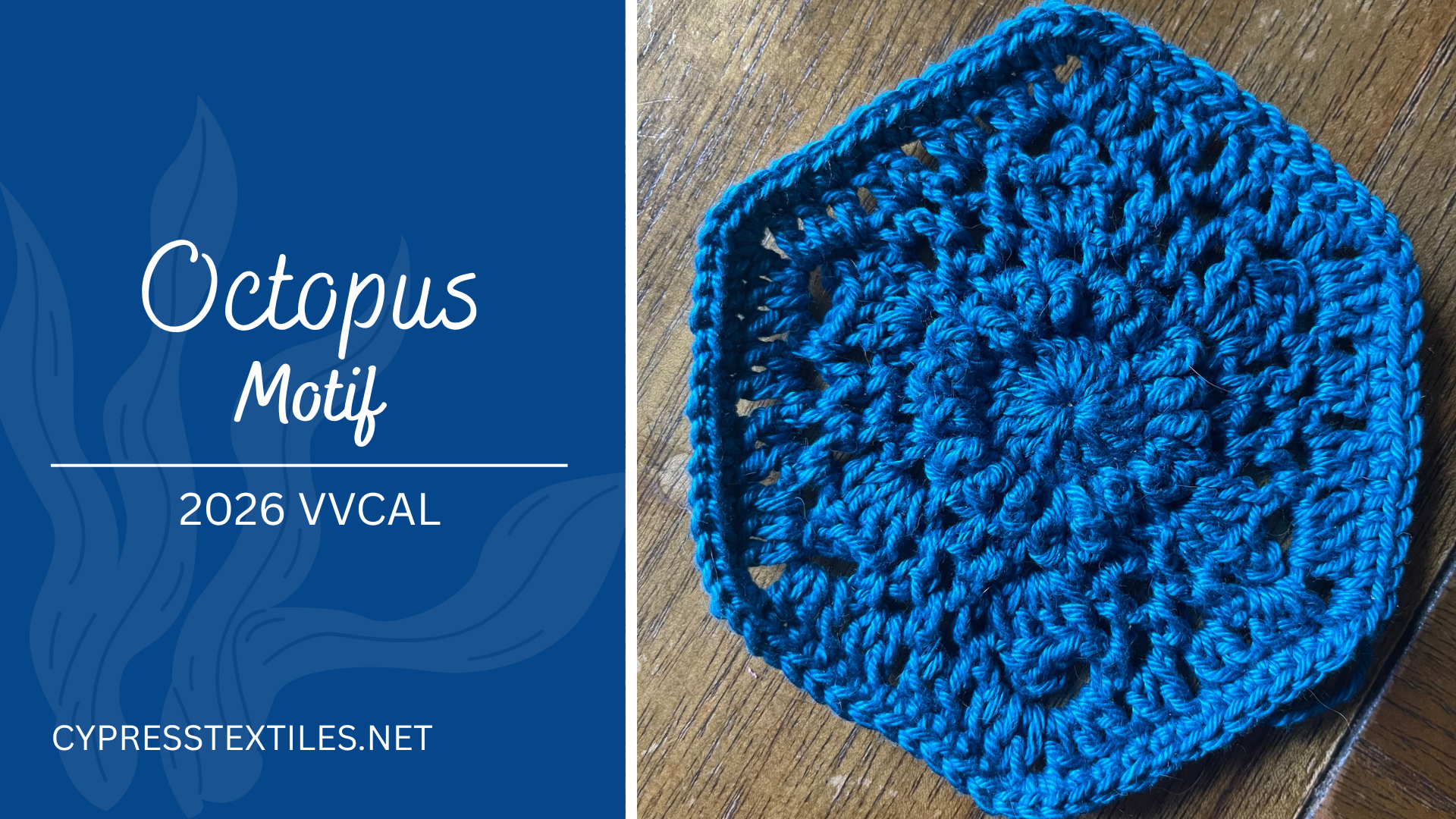
Octopus Motif
Find the Ravelry Page for this motif here and add your project!

–
Enjoy a small reflection on one of this week’s featured sea creatures.

–

–

–
Fun Facts
Octopuses have blue blood. Not from royal genes, but from copper. Unlike a lot of other marine invertebrates, octopuses have a high metabolic rate, and therefore a high demand for oxygen. Copper-based hemocyanin is more efficient for transporting oxygen at low temperatures and low oxygen concentrations than is the iron-based hemoglobin that makes our blood red.
They also have three hearts: two just to pump blood through the gills and one more to circulate it to the organs. The circulating heart stops beating while an octopus swims, which explains why these cephalopods prefer crawling: swimming exhausts them.
On the other hand, all octopuses (plus all cuttlefishes and some squids) are venomous, although only the blue-ringed octopus of Australia is dangerous to humans. Injected as an octopus drills into its prey with its beak, the venom fatally paralyzes an animal that could otherwise injure the squishy invertebrate in a struggle. It also begins the digestive process. Researchers have discovered that octopus venom contains proteins similar to those produced by pufferfish and porcupinefish as well as by some venomous snakes.
Their eight arms can perform separate tasks simultaneously thanks to a large nerve cluster, like a minibrain, at the base of each controlling its movement. The curling and unfurling arms, dotted with more than 2,000 individually moving suction cups, contain two-thirds of the animal’s neurons. The suckers are equipped with chemical sensors that not only feel, but taste and smell as well. So while an octopus concentrates on hunting, its arms are moving it forward, testing the water and ocean floor, probing coral crevices and maybe even prying open a clam already caught.
Octopuses are standouts among cephalopods, and among all invertebrates, for their large brains. They can navigate mazes, solve problems, remember, predict, use tools and take apart just about anything from a crab to a lock — all but that last one sophisticated hunting behaviors. Shedd’s aquarists provide our resident giant Pacific octopus with stimulating activities (and enable it to participate in its own wellness care) through regular training sessions that apply the same positive-reinforcement techniques used with the marine mammals. They also offer the octopus enrichment, including a variety of toys and favorite treats, the latter sometimes given as “prey puzzles” in screw-top jars.
Octopus Motif Pattern
Reference
- 2026 VVCAL Main Page for measurement, gauge, and materials information
- Week 11 Instruction post to see how many motifs to make, and in what colors
- Tips and Tricks post if you have general questions
Scroll for chart and video instruction.
Stitch Guide (US Terms)
Note: Scroll down for UK Terms.
- beg beginning
- beg dc (1sc, ch1) – counts as 1 dc
- chN chain N number of times
- dc double crochet
- MR make ring: slip knot, ch3, ss in third ch from hook
- picot ch3, sc in third ch from hook
- sc single crochet
- sp space (ch-sp = chain space)
- ss slip stitch
- st stitch
- tr treble crochet
- yoh yarn over hook
Written Instructions & Step-by-step Photos (US Terms)
Rnd 1 MR, beg dc, 17dc, ss in beg dc. [18 dc]

–
Rnd 2 [1sc, 1tr] in next st 18 times, ss in first sc – note: tr sts make tinny bobbles on RS of work. [18 tr, 18 sc]

–
Rnd 3 [1sc in next sc st, ch3] 18 times, ss in first sc. [18 sc, 18 sp]

–
Rnd 4 Ss in 1 ch, 1sc in same ch-sp, [ch3, 1sc in next sp, ch3, (2dc, picot, 2dc) in next sp, ch3, 1sc in next sp] 6 times omitting final sc on sixth rep, ss in first sc. [6 picot, 24 dc, 12 sc, 18 sp]

–
Rnd 5 Ss in 1 ch, 1sc in same ch-sp, [ch3, 1sc in next sp, ch5, 1sc in next sp, ch3, 1sc in next sp] 6 times omitting final sc on sixth rep, ss in first sc. [18 sc, 18 sp]

–
Rnd 6 Ss in 1 ch, beg dc in same ch-sp, [1dc in same sp, (3dc, ch1, 3dc) in ch-5 sp, 2dc in next sp, ch1, 1dc in next sp] 6 times omitting final dc on sixth rep, ss in beg dc. [60 dc, 12 sp]

–
Rnd 7 [4sc, 3sc in next ch-sp, 7sc] 6 times, ss in first sc, cut yarn. [84 sc]

–
Stitch Guide (UK Terms)
- beg beginning
- beg tr (1dc, ch1) – counts as 1 tr
- chN chain N number of times
- dc double crochet
- dtr double treble crochet
- MR make ring: slip knot, ch3, ss in third ch from hook
- picot ch3, dc in third ch from hook
- sp space (ch-sp = chain space)
- ss slip stitch
- st stitch
- tr treble crochet
- yoh yarn over hook
Written Instructions & Step-by-step Photos (UK Terms)
Rnd 1 MR, beg tr, 17tr, ss in beg tr. [18 tr]

–
Rnd 2 [1dc, 1dtr] in next st 18 times, ss in first dc – note: dtr sts make tinny bobbles on RS of work. [18 dtr, 18 dc]

–
Rnd 3 [1dc in next dc st, ch3] 18 times, ss in first dc. [18 dc, 18 sp]

–
Rnd 4 Ss in 1 ch, 1dc in same ch-sp, [ch3, 1dc in next sp, ch3, (2tr, picot, 2tr) in next sp, ch3, 1dc in next sp] 6 times omitting final dc on sixth rep, ss in first dc. [6 picot, 24 tr, 12 dc, 18 sp]

–
Rnd 5 Ss in 1 ch, 1dc in same ch-sp, [ch3, 1dc in next sp, ch5, 1dc in next sp, ch3, 1dc in next sp] 6 times omitting final dc on sixth rep, ss in first dc. [18 dc, 18 sp]

–
Rnd 6 Ss in 1 ch, beg tr in same ch-sp, [1tr in same sp, (3tr, ch1, 3tr) in ch-5 sp, 2tr in next sp, ch1, 1tr in next sp] 6 times omitting final tr on sixth rep, ss in beg tr. [60 tr, 12 sp]

–
Rnd 7 [4dc, 3dc in next ch-sp, 7dc] 6 times, ss in first dc, cut yarn. [84 dsc]

–
Chart
Note: Chart is meant as a visual guide to the written instruction and might not be able to stand alone due to special stitches.

–
Video
Coming shortly!
–
Note: Video is spoken in US Terms.
Subscribe on YouTube for more videos like this one!
Links to Weekly Instruction Posts
Quick Links to Each Week: 1/2/3/4/5/6/7/8/9/10/11/12/13/14/15/16/17/18/19/20
Pin the Motif!

–

–
Thank you so much for stopping in for this week of the 2026 VVCAL!
2026 VVCAL Quick Links
- 2026 VVCAL Main Information Page
- 2026 VVCAL FAQ Tips & Tricks Page
- 2026 VVCAL Ravelry ebook Motifs link back to their blog posts. Favorite the hexagon, add it to your Ravelry queue, see others’ projects, and more!
- Vibrant Vintage CAL (Official) Facebook Group Post VVCAL WIP/FO pics, ask questions, post your FO pic of the previous years’ VVCAL blankets.
- CypressTextiles Tree Huggers Facebook Group – This is my main FB group (join!). Share your VVCAL progress pics in this group if you like, and I will share CAL highlights here, but the weekly action will be in the other group linked above.
- YouTube Channel (Subscribe!) – Here I will be posting CAL pattern videos weekly for the duration of the CAL.
You may also enjoy these completed CALs
- VVCAL (2016)
- VVCAL (2018)
- VVCAL (2020)
- VVCAL (2022)
- VVCAL (2024)
- Dutch Rose CAL
- Botanica Blanket CAL
Happy crafting,
Rachele C.
Support My Work
You’re supporting by just being here! You can read my blog (Start Here!), like and comment on socials, and message me for a chat. All of this supports my work free of charge!
- Affiliate links – Shopping through my links supports me at no additional cost to you as I get a small commission through my affiliates. Jimmy Beans Wool // WoolWarehouse // Amazon.com
- Buy my pattern book – I wrote a super neat crochet blanket pattern book, published under Penguin Random House. You can buy it here!
- Browse my self-published patterns – I have over a hundred patterns on Etsy and Ravelry
- Creative Art Blanket Course – Check it out on Podia
Where to Find Me
- Instagram: @cypresstextiles
- Facebook Page: CypressTextiles
- YouTube Channel: Rachele Carmona
- Pinterest: CypressTextiles
- Tumblr: CypressTextiles
- Etsy: CypressTextiles
- Ravelry: Rachele Carmona
- Podia: Creative Art Blanket Course