
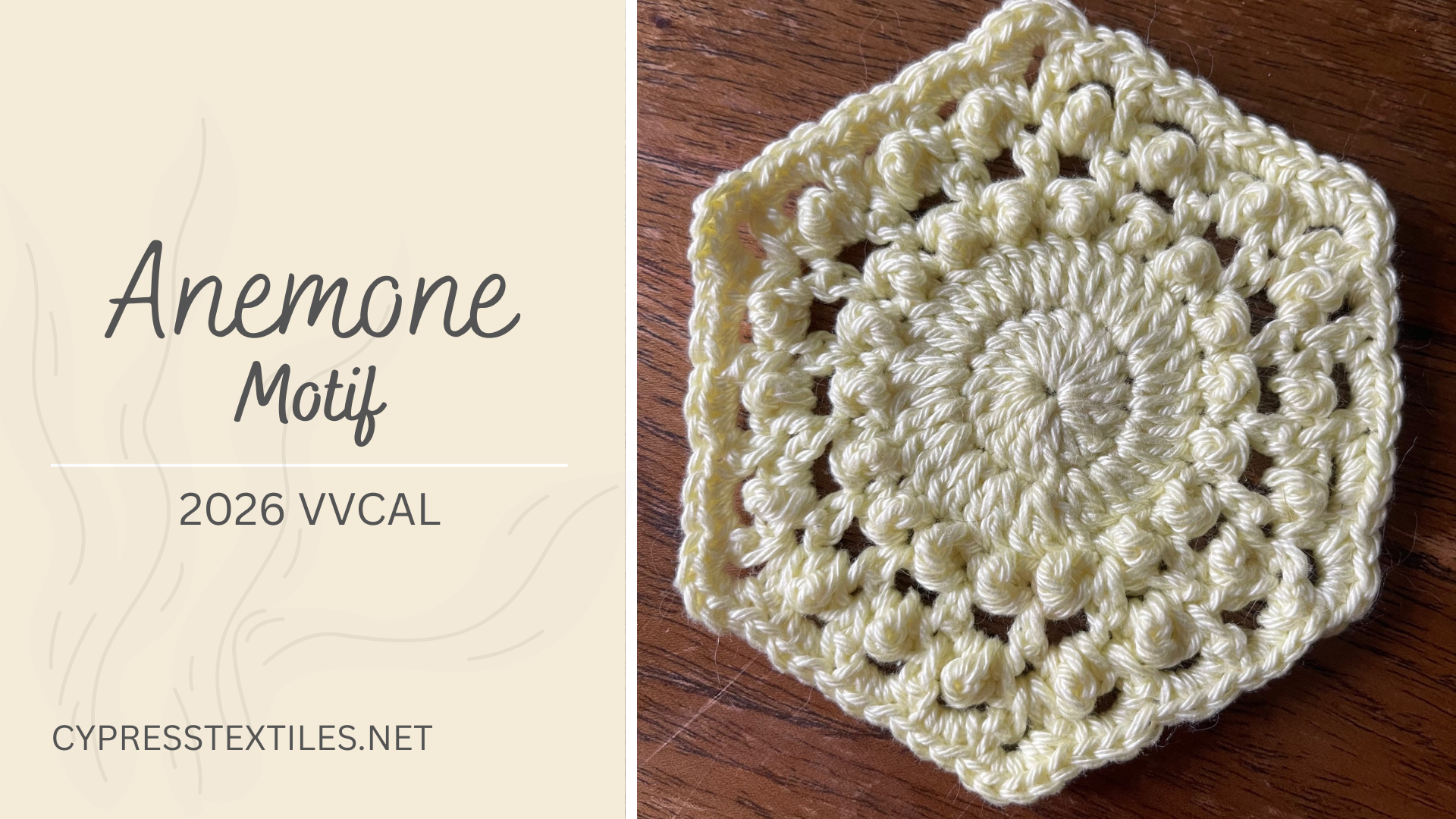
Hello, and a huge welcome to this week of the 2026 Vibrant Vintage Crochet-A-Long (VVCAL)! I’m so glad you’re here! I love spending this time with the VVCAL community. We are going to have so much fun relaxingly working through these motifs each week.
Attention!
If you have not yet seen the Week 5 Instruction post, please head there first and see the instructions for the version that you are working. Below, you will find the Motif pattern, in US, and UK Terms, Chart, Video, and Step by step photos.
Social Media Hashtags: #VVCAL and #CypressTextiles
PDF Version
2026 VVCAL PDF is now available! In US and UK terms
- 36 hexies to mix and match
- 3 Joining methods
- Wide Lace Border
- US and UK Terms included
MEGA PACK! Of course I have also created a value bundle for you – 2022, 2024, and 2026 VVCAL PDFs US and UK Terms – Hexagon VVCAL Mega Pack Available on:
2026 VVCAL Quick Links
- 2026 VVCAL Main Information Page
- 2026 VVCAL FAQ Tips & Tricks Page
- 2026 VVCAL Ravelry ebook Motifs link back to their blog posts. Favorite the hexagon, add it to your Ravelry queue, see others’ projects, and more!
- Vibrant Vintage CAL (Official) Facebook Group Post VVCAL WIP/FO pics, ask questions, post your FO pic of the previous years’ VVCAL blankets.
- CypressTextiles Tree Huggers Facebook Group – This is my main FB group (join!). Share your VVCAL progress pics in this group if you like, and I will share CAL highlights here, but the weekly action will be in the other group linked above.
- YouTube Channel (Subscribe!) – Here I will be posting CAL pattern videos weekly for the duration of the CAL.
Anemone Motif
Find the Ravelry Page for this motif here and add your project!

–
Enjoy a small reflection on one of this week’s featured sea creatures.

–

–

–
Five Fun Facts
Sea anemones are named after and resemble flowers, but they’re actually invertebrates related to corals and jellies. Their bodies consist of a soft, cylindrical stalk topped by an oral disc surrounded with venomous tentacles. They’re animals, not plants!
At their base, they sport a single adhesive foot, called a basal disc, which they use to attach to underwater surfaces like rocks or shells. Anemones can have anywhere from a dozen to a few hundred tentacles. These cnidarians come in a variety of colors, decorating a tide pool or reef like a garden of wildflowers.
Anemones are known to form symbiotic relationships with other animals; their most well-known alliance is with clownfish. Because of a protective mucous coating, clownfish are immune to an anemone’s stinging cells. They make their homes within the anemone’s tentacles, protected from predators; in return, the anemone eats the clownfish’s leftover meals.
When they are in their larval stage (before they reach the adult stage), they begin to swim and are much more active than when they reach maturity. Anemones typically attach to a surface and stay there for the remainder of their life. However, they can detach and move along with the current if required.
Like jellyfish, anemones possess paralyzing neurotoxins in their cnidocytes (stinging cells). When approached by prey, they use their tentacles to immobilize and move them closer to their mouths. These tentacles are pretty flexible and can self-regenerate. Many common anemone species are not able to sting humans as our skin is too thick, and anemones are adapted for stinging microorganisms.
Anemone Motif Pattern
Reference
- 2026 VVCAL Main Page for measurement, gauge, and materials information
- Week 5 Instruction post to see how many motifs to make, and in what colors
- Tips and Tricks post if you have general questions
Scroll for chart and video instruction.
Stitch Guide (US Terms)
Note: Scroll down for UK Terms.
- beg beginning
- beg dc (1sc, ch1) – counts as 1 dc
- chN chain N number of times
- dc double crochet
- MR make ring: slip knot, ch3, ss in third ch from hook
- sc single crochet
- sp space (ch-sp = chain space)
- ss slip stitch
- st stitch
- tr treble crochet
- yoh yarn over hook
Written Instructions & Step-by-step Photos (US Terms)
Rnd 1 MR, beg dc, 17dc, ss in beg dc. [18 dc]

–
Rnd 2 Beg dc in first st, 1dc in same st, 2dc in next 17 sts, ss in beg dc. [36 dc]

–
Rnd 3 [1sc, 1tr] 18 times – note: tr sts form tiny bobbles on RS of work, ss in first sc. [18 tr, 18 sc]

–
Rnd 4 Ss in next st, [1sc in next sc, ch3] 18 times, ss in first sc. [18 sc,18 sp]

–
Rnd 5 [1sc, 1tr, 1sc, ch1] in each ch-sp around – note: tr sts form tiny bobbles on RS of work, ss in first sc. [18 tr, 36 sc, 18 sp]

–
Rnd 6 Ss in next 2 sts, [1sc in next ch-sp, ch3, (1sc, ch3, 1sc) in next sp, ch3, 1sc in next sp, ch3] 6 times, ss in first sc. [24 sc, 24 sp]

–
Rnd 7 [3sc in next sp, 5sc in next sp, 3sc in next 2 sps] 6 times, ss in first sc, cut yarn. [84 sc]

–

–
Stitch Guide (UK Terms)
- beg beginning
- beg tr(1dc, ch1) – counts as 1 tr
- chN chain N number of times
- dc double crochet
- dtr double treble crochet
- MR make ring: slip knot, ch3, ss in third ch from hook
- sp space (ch-sp = chain space)
- ss slip stitch
- st stitch
- tr treble crochet
- yoh yarn over hook
Written Instructions & Step-by-step Photos (UK Terms)
Rnd 1 MR, beg tr, 17tr, ss in beg tr. [18 tr]
–
Rnd 2 Beg trin first st, 1tr in same st, 2tr in next 17 sts, ss in beg tr. [36 tr]
–
Rnd 3 [1dc, 1dtr] 18 times – note: dtr sts form tiny bobbles on RS of work, ss in first dc. [18 dtr, 18 dc]
–
Rnd 4 Ss in next st, [1dc in next dc, ch3] 18 times, ss in first dc. [18 dc, 18 sp]
–
Rnd 5 [1dc, 1dtr, 1dc, ch1] in each ch-sp around – note: dtr sts form tiny bobbles on RS of work, ss in first dc. [18 dtr, 36 dc, 18 sp]
–
Rnd 6 Ss in next 2 sts, [1dc in next ch-sp, ch3, (1dc, ch3, 1dc) in next sp, ch3, 1dc in next sp, ch3] 6 times, ss in first dc. [24 dc, 24 sp]
–
Rnd 7 [3dc in next sp, 5dc in next sp, 3dc in next 2 sps] 6 times, ss in first dc, cut yarn. [84 dc]
–
–
Chart
Note: Chart is meant as a visual guide to the written instruction and might not be able to stand alone due to special stitches.

–
Video
–
Note: Video is spoken in US Terms.
Subscribe on YouTube for more videos like this one!
Links to Weekly Instruction Posts
Quick Links to Each Week: 1/2/3/4/5/6/7/8/9/10/11/12/13/14/15/16/17/18/19/20
Pin the Motif!

–

–
Thank you so much for stopping in for this week of the 2026 VVCAL!
2026 VVCAL Quick Links
- 2026 VVCAL Main Information Page
- 2026 VVCAL FAQ Tips & Tricks Page
- 2026 VVCAL Ravelry ebook Motifs link back to their blog posts. Favorite the hexagon, add it to your Ravelry queue, see others’ projects, and more!
- Vibrant Vintage CAL (Official) Facebook Group Post VVCAL WIP/FO pics, ask questions, post your FO pic of the previous years’ VVCAL blankets.
- CypressTextiles Tree Huggers Facebook Group – This is my main FB group (join!). Share your VVCAL progress pics in this group if you like, and I will share CAL highlights here, but the weekly action will be in the other group linked above.
- YouTube Channel (Subscribe!) – Here I will be posting CAL pattern videos weekly for the duration of the CAL.
You may also enjoy these completed CALs
- VVCAL (2016)
- VVCAL (2018)
- VVCAL (2020)
- VVCAL (2022)
- VVCAL (2024)
- Dutch Rose CAL
- Botanica Blanket CAL
Happy crafting,
Rachele C.
Support My Work
You’re supporting by just being here! You can read my blog (Start Here!), like and comment on socials, and message me for a chat. All of this supports my work free of charge!
- Affiliate links – Shopping through my links supports me at no additional cost to you as I get a small commission through my affiliates. Jimmy Beans Wool // WoolWarehouse // Amazon.com
- Buy my pattern book – I wrote a super neat crochet blanket pattern book, published under Penguin Random House. You can buy it here!
- Browse my self-published patterns – I have over a hundred patterns on Etsy and Ravelry
- Creative Art Blanket Course – Check it out on Podia
Where to Find Me
- Instagram: @cypresstextiles
- Facebook Page: CypressTextiles
- YouTube Channel: Rachele Carmona
- Pinterest: CypressTextiles
- Tumblr: CypressTextiles
- Etsy: CypressTextiles
- Ravelry: Rachele Carmona
- Podia: Creative Art Blanket Course