
2200 words // 12min read time
Before I begin – see what’s left in the blanket sale! Just a few blankets left! US Only.
Hello, fellow creative! Today, I’m going to share a book review/report with you. I look forward to sharing many titles in these reports and connecting them to my Creative Journey Series. I believe as creatives it is so important for us to study the works of others, and use the creative tools that other artists have provided. Seeing the field of art through many perspectives and lenses is crucial to growing ourselves as artists.
Whether you purchase these books second-hand, or check them out from a library, I can say that I recommend perusing them, taking them in, and processing their contents. Sometimes I will review a book that is written by an author who means to help us with our art, and sometimes I will review a curated art book that has a few editors and focuses on the artworks of a certain artist. In both cases, there is something to be learned and inspiration to be gathered.
Without further ado, I present:
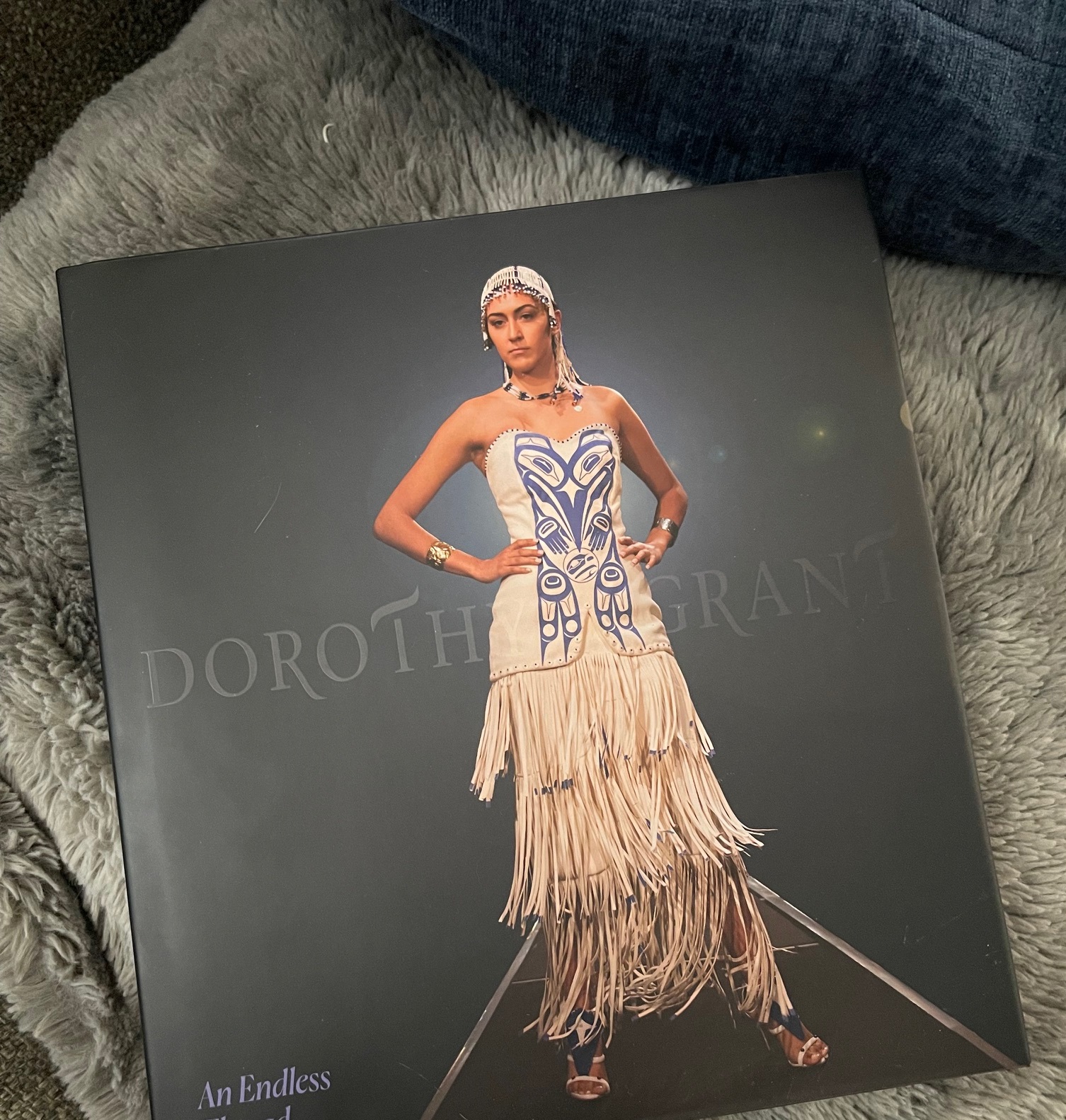
Dorothy Grant: An Endless Thread, by Dorothy Grant
Why this book?
I chose An Endless Thread for Part 12 of my Artist’s Journey series because Dorothy Grant’s story is about returning to what matters most. After navigating the middle space of burnout, experimentation, and doubt, I found myself wanting to reconnect with the why of making. Grant’s work is a powerful example of what happens when an artist reclaims her voice, honors her heritage, and fuses tradition with contemporary expression. Her designs are cultural continuity in motion.
From the Amazon page found here: “An Endless Thread serves as a long-overdue celebration of Grant, who has long advocated for the intersection of cultural pride, style, and a maintaining of tradition.”
– Vogue
“Part look-book, part memoir, and part history, this beautifully illustrated monument to a singular designer who helped inspire the growing Indigenous fashion movement is also a powerful demonstration of the enduring resonance and possibilities of Haida art. Inspired by a discussion with celebrated Haida artist Bill Reid, Haida designer Dorothy Grant made it her life’s mission to bring her culture’s traditional art into contemporary fashion while adhering to the principle of Yaguudang, or respect for oneself and others.
Dorothy Grant: An Endless Thread is the first monograph to celebrate her trailblazing career. It features new photography of dozens of garments spanning the past four decades, modeled in studio and natural settings in Vancouver and Haida Gwaii, alongside sketches, traditional button robes and spruce-root weaving, and personal stories and reflections from Grant.”

–
This is 100% a book that you can use as a source of inspiration during Part 12 of the Creative Journey, “Artistic Evolution – Never Stop Growing”. Here is a link to that post to take a deep dive into getting started. Just flip open the book, read about the life and garment art of Dorothy Grant, and get instantly and ascendingly inspired.
About the Author/Artist
This beautifully produced catalog celebrates the work of Dorothy Grant, a Haida fashion designer based in British Columbia. The book blends full-color photographs, personal essays, and contextual commentary that reflect her dual identity as artist and cultural steward. While not written by Grant herself, the volume includes her voice through interviews and reflections. It’s curated with respect and reverence, presenting Grant’s career as a bold act of Indigenous presence in contemporary fashion. The tone is both celebratory and rooted in legacy.
Internationally renowned fashion designer and traditional Haida artist Dorothy Grant’s strong connection to her culture and Haida identity has been the driving creative force and her foundation as a contemporary fashion designer for over the past thirty-two years. In 1988, Grant became the first to merge Haida art and fashion utilizing her formal training at the Helen Lefeaux School of Fashion Design.
Dorothy believes that her clothing embodies the Haida philosophy Yaangudang meaning “self respect.” The driving force behind her clothing designs is “empowerment, pride and feeling good about oneself.”
After seventeen years in retail and manufacturing, Grant has transformed her entrepreneurial focus to Native art market trade shows. She continues to make one of a kind garments for her clients and she shows in various art markets in Alaska, California, New Mexico, New York and various cities in Canada.
According to CBC Radio: “She was the first fashion designer to combine haute couture with her Haida culture and 30 years later, Dorothy Grant is still sharing her unique style with the world. In 1987 Grant pursued formal training at the Helen Lefeaux School of Fashion Design in Vancouver and said it was always her intention to put her culture on her clothes.
“I think what a lot of people don’t know is that I was a traditional fabric artist,” she explained. “Haida weaving, spruce basketry and hats and button blanket making. I made a lot of regalia for dance groups. It sort of evolved into this idea of applying Haida art onto clothing and that’s basically the roots of it.”

–
Read an incredible interview on ActiveHistory.ca.
She has put her graceful Haida art of ravens, hummingbirds and Orcas on wool and cashmere scarves, suits and silk gowns and even purses.”
Excerpt:
LUBY: What inspired you to use fashion – to use garments as a medium – for sharing Haida art, Haida histories?
GRANT: Haida art has a look of almost universality to it. It has to do with the “Innovation” idea – that art should not be stagnant, but progressive, no matter what the culture. As for Haida people, we have always looked for new mediums to convey Haida Art. This way, we keep ownership of it and no one else can say they did that first. Think of fashion as a bridge between cultures. It’s a way for people of nations –
LUBY: Of different nations?
GRANT: Yes – of nations to understand the art in fashion, rather than a totem pole. It becomes more communal.
–

–
Life Timeline
From the book, here is the timeline of Grant’s life.

–
And a lovely shot of Grant herself.

–
Their Websites and Links
Overview and Core Themes
Grant’s use of bold black lines, red accents, and the flowing geometry of Haida formline design is striking. She often builds garments around a single powerful shape or symbolic image, letting the lines dictate structure and motion. There’s a harmony in how the graphics move with the body. Even in her more minimal looks, the visual impact is deliberate and potent. For makers and fiber artists, this invites reflection on how motifs can carry meaning, not just texture or rhythm, but cultural and personal weight. Her work shows how composition can be both beautiful and declarative.
The biggest takeaways of the book:
- Grant fuses Haida art and Western fashion, creating a body of work that asserts Indigenous presence on the runway and in daily life.
- Cultural identity is central, not decorative. Every garment, from robes to power suits, carries ancestral meaning and artistic intent.
- Her career is built on courage. In 1989, she opened the first Indigenous-owned fashion boutique in North America.
- Storytelling is woven into the structure. Grant’s work uses formline shapes, crests, and traditional iconography not as motifs but as narrative anchors.
- Resurgence is embodied. Her work is a living reclamation and a way to wear culture forward.

–
Themes and Artist’s Purpose
From The British Columbian Quarterly: “In 2010, scholar Jessica Metcalfe featured the trailblazing Haida designer Dorothy Grant in her seminal PhD thesis on Native fashion, noting that “Native fashion designers in the Northwest Coast region deserve further research”. Dorothy Grant: An Endless Thread is a joyously written, designed, and illustrated book that significantly contributes to this deserving art and design history. The volume bills itself as “part look-book, part memoir, and part history,” and delivers. Between a sweeping new photo shoot of Grant’s work and the plethora of personal stories and historical context from contributors and the designer herself, the book provides long-needed documentation of Grant’s major impact on Haida art and on fashion more broadly alongside the people she holds dear.
Throughout, images shot in 2023 by photographer Farah Nosh show Grant’s pieces in exuberant embodiment. The clothes are modeled by Haida friends and other colleagues of all ages on Haida Gwaii and in Coast Salish territory, sometimes with Grant attending and featured. The photographs convey a palpable sense of community while visually recontextualizing Grant’s work. Collectively, they allow the viewer to appreciate the durable coherence of Grant’s design principles: for example, her sensitivity to aesthetic balance on the body, to positive and negative space, and to her discerning use of bold, declarative surfaces such as the shawl collar—and to notice when the designer has pushed herself.”

–
Haida Art and Western Culture Fusion
Haida art, originating from the indigenous Haida people of Haida Gwaii, is a rich and sophisticated art form characterized by intricate designs, symbolic imagery, and a strong connection to the natural world and oral traditions. It is deeply intertwined with their culture, history, and spiritual beliefs.
Works by Haida artist, Bill Reid.

–
- Formline System: Haida art utilizes a sophisticated system of lines called “formlines” to create designs, often depicting animals, humans, and supernatural beings.
- Symbolism: Many Haida artworks incorporate symbolic imagery related to crests, clan lineage, and spiritual beliefs.
- Materials: Traditional Haida art uses materials like red and yellow cedar for carvings, argillite (a black slate found on Haida Gwaii) for sculptures, and silver and gold for jewelry.
- Colors: The primary colors used in Haida art are black and red, often with blue-green accents.
- Bilateral Symmetry: A common design principle is bilateral symmetry, where the artwork is mirrored along a central line.
- Ovoid and U-forms: The ovoid (an oval-to-rectangular shape) and U-form are fundamental design elements used to represent eyes, joints, and other anatomical details.
- Integration with Everyday Objects: Haida art is not just for ceremonial or decorative purposes; it is integrated into everyday objects like bentwood boxes, tools, and even house posts.

–
Examples of Haida Art:
- Totem Poles: Tall, elaborately carved poles depicting clan crests and stories.
- Argillite Carvings: Sculptures made from the unique black slate, often depicting mythological figures and crest animals.
- Bentwood Boxes: Rectangular boxes crafted from steamed cedar planks, used for storage and adorned with intricate carvings.
- Ceremonial Masks: Elaborately carved and painted masks used in potlatches and other ceremonies.
- Jewelry: Silver and gold jewelry featuring Haida designs and symbolism.
Contemporary Haida Art: Modern Haida artists continue to explore and adapt traditional techniques and imagery while also incorporating contemporary themes and materials.
Dorothy’s Works
It was hard to choose, but I made a selection of Grant’s works from the book. I recommend getting it to see all of them. Grant’s artistic journey began with ceremonial works in the early 1980s, when she began making ceremonial button robes and learned spruce root weaving from master Haida weaver Florence Davidson. In the mid-1980s, rising to a challenge by celebrated Haida artist Bill Reid, Grant set her sights on bridging the world of Haida art and regalia with that of western fashion and haute couture.

–
Pursuing a formal fashion education at the Helen Lefeaux School of Fashion Design, she debuted her first label, Feastwear, in 1989 with a fashion show in Vancouver that featured 55 pieces, garnering great excitement. This event marked the beginning of Dorothy Grant’s multi-decade career in fashion.

–
A word on Haida Threads.

–
Menswear – Stunning

–

–
And a gorgeous pair of coordinating dresses.

–
Final Thoughts
Would I recommend reading this book? Yes, for anyone who wants to learn more about the culture and Dorothy Grant’s mission and fashion art. What an absolute treasure of a body of work. You can flip through these pages again and again and get inspired to create your own works inspired by your own culture.

–
Thanks so much for checking out my analysis of this book. The free crochet motif that goes along with this book report will be released soon! Hope you have a great week, and happy crafting!
Rachele C.
Order my crochet pattern book: The Art of Crochet Blankets
You may also enjoy:
Support My Work
You’re supporting by just being here! You can read my blog (Start Here!), like and comment on socials, and message me for a chat. All of this supports my work free of charge!
- Affiliate links – Shopping through my links supports me at no additional cost to you as I get a small commission through my affiliates. Jimmy Beans Wool // WoolWarehouse // Amazon.com
- Buy my pattern book – I wrote a super neat crochet blanket pattern book, published under Penguin Random House. You can buy it here!
- Browse my self-published patterns – I have over a hundred patterns on Etsy //Ravelry//My Podia Shop
- Creative Art Blanket Course – Check it out on Podia
Where to Find Me
- Instagram: @cypresstextiles
- Facebook Page: CypressTextiles
- YouTube Channel: Rachele Carmona
- Pinterest: CypressTextiles
- Tumblr: CypressTextiles
- Etsy: CypressTextiles
- Ravelry: Rachele Carmona
- Podia: Creative Art Blanket Course